When Displaying Every Keepsake Crowds the Story
A keepsake display can honour treasured objects without showing them all at once. Learn to choose, rotate and arrange a small group with care.
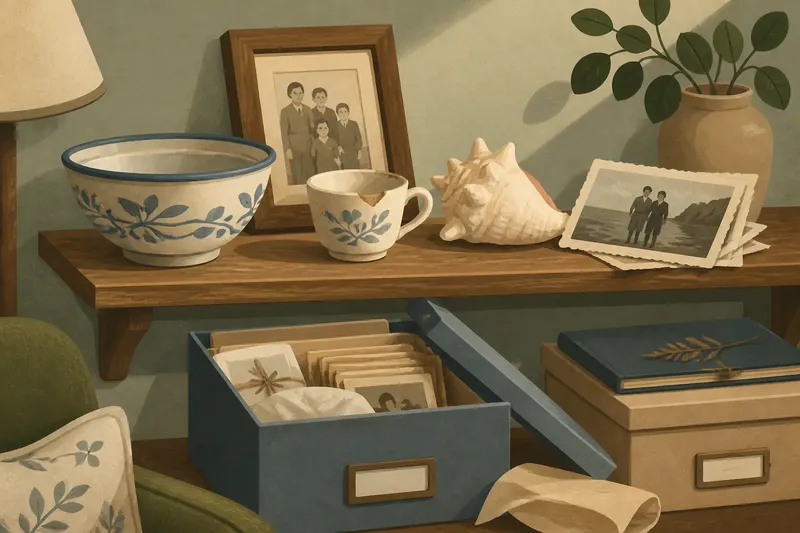
A shelf holds a holiday shell, a chipped cup from an aunt and a stack of family photographs, but the eye keeps sliding past them all. A thoughtful keepsake display need not show every treasured object at once; choosing a small group can make each piece easier to notice and enjoy.
That can feel uncomfortable at first. Putting a keepsake away may seem like diminishing its importance, especially when it carries a story that deserves to be remembered. The useful distinction is between preserving an object and displaying it: one is about keeping it safe, the other about giving it attention in a room.
Why does a keepsake display start to feel crowded?
When every meaningful object is visible, each one competes for the same attention. A crowded shelf can blur differences in shape, colour and significance, so a small handmade bowl may disappear beside framed photographs and souvenirs. The objects have not lost their meaning; the arrangement has made it harder to see them individually.
The cause is often an understandable wish to honour everyone and every occasion. But a display is not an inventory of affection. It is a scene in a room, and scenes need open space around their most important details.
Try removing the objects temporarily and looking at the bare surface. Return only the pieces that suit the room and have a clear reason to be seen there. Keep the rest in a suitable storage place, where they can be brought out when the display changes.
What if putting something away feels disloyal?
A keepsake can matter deeply without being on view every day. Visibility is not a measure of love, gratitude or memory; it is simply a choice about what the room shows at this moment. Separating those ideas can make editing feel less like rejection.
It may help to give stored pieces a deliberate place rather than letting them drift into a miscellaneous box. Use an acid-free tissue wrap for delicate paper items, a padded box for fragile objects, or a labelled archival box for a small collection of photographs. Choose materials suited to the object, and avoid sealing anything away if its care instructions call for ventilation.
Say you have a set of postcards from a relative, several of which are currently pinned across a kitchen noticeboard. You might choose one card for the board, place the others in a labelled folder, and swap the featured card when you next want to revisit the collection. The visible card has room to be read, while the folder keeps the wider story together for another day.
How can you choose which keepsakes stay on view?
Start with the place, not the full collection. A narrow mantel, bedside table or bookcase shelf has its own scale and use; the right display should sit comfortably there rather than take over the surface.
Then ask what role each object would play. One might carry the central memory, another provide a different texture, and a third connect the arrangement to the room. If two objects tell much the same story or demand attention in the same way, consider displaying one and storing the other for a later rotation.
Useful questions include:
- Can I see this object clearly? If a frame or ornament is hidden behind another piece, move it forward or choose a different surface.
- Does it belong in this room? A kitchen keepsake may feel at home near a breakfast table, while a delicate paper item may be better placed away from steam and splashes.
- Does it have space around it? A little empty surface can separate one object’s outline from another.
- Am I displaying it from habit? If it has become background, put it away for now and see whether you miss seeing it.
- Can I care for it here? Sunlight, dust, handling and moisture affect objects differently; select a position appropriate to the material.
These are prompts, not rules. A family may choose to keep a whole set together because the relationship between the pieces is the story. In that case, a larger shelf or a cabinet with clear space may serve them better than forcing the set into a crowded corner.
What causes a display to look unrelated?
A collection can feel scattered when objects have no visible connection, even if each is important to its owner. The link might be a shared person, a journey, a material or a particular period of family life. Without that thread, several small stories can compete without forming a legible arrangement.
Try grouping pieces around one connection and letting that connection guide what stays visible. A small ceramic dish beside a photograph from the same household may read as a pair; a postcard and a shell from one trip may sit together more naturally than alongside unrelated ornaments. Keep the explanation simple: the objects should still be enjoyable without a written caption for each one.
If an object’s story is easy to forget, a discreet handwritten note on the underside of a box or in a nearby album can preserve the detail without turning the display into a label board. For a shared home, a short note may also help others understand why a piece matters before they move or clean it.
How can you rotate keepsakes without making the shelf feel unsettled?
Rotation works best when it has a manageable rhythm. You might change a display with the seasons, after a family visit, or when a particular memory feels timely. There is no need for a strict schedule; a regular occasion simply makes the choice easier to remember.
Keep a small reserve together, so choosing the next group does not mean searching through unrelated storage. A labelled box or drawer can hold pieces that are not currently displayed. Store fragile items with appropriate padding, keep photographs away from damp areas, and make sure the arrangement remains easy to access without shifting other possessions.
When changing the display, take a moment to notice what has been catching your eye and what has faded into the background. That observation gives you a useful guide for the next arrangement. A piece that has been away for a while may feel newly vivid; another may be more satisfying kept safe and brought out for a particular conversation.
What if different people want different objects displayed?
In a shared home, one person may see a crowded shelf while another sees a comforting collection. Avoid treating the decision as a contest over whose memories matter more. Instead, agree on the available display space and take turns selecting a small group, or give each person a separate surface that suits the room.
For keepsakes connected to someone who is no longer there, a rotation can also make room for several parts of that person’s story. One month might feature a recipe card; another arrangement might include a small tool or a photograph. The change does not erase what is put away. It lets the room make space for a different detail.
If a disagreement centres on a fragile, valuable or delicate item, check its care guidance before choosing a position or handling routine. Where an item needs specialist conservation, ask an appropriate conservator rather than relying on improvised household methods.
Which questions help with a keepsake display?
How many keepsakes should I display together?
Choose as many as the surface can hold while each remains visible and the arrangement still feels calm. The useful limit depends on the objects’ size, shape and relationship, not on a fixed count.
Should related keepsakes always stay together?
Keep a group together when seeing the pieces as a set helps tell its story. If one item is easily lost among the others, try displaying it alone and store the rest together so the collection remains intact.
Where should I store keepsakes that are not on display?
Use a clean, dry place suited to the material, with protective wrapping or a sturdy box where needed. Keep the storage location easy to identify, and follow the maker’s or conservator’s care advice for delicate objects.
How often should I rotate a display?
Change it when you want a different memory in view, or link the change to an occasion you already notice. A rotation should feel like a choice, not another household task to keep up with.
What makes a smaller display feel complete?
A display feels complete when its objects have room to be seen and a reason to sit together. A photograph, a small vessel and a keepsake from a journey can form a satisfying arrangement if their shapes balance and their stories connect. Leaving an open patch of shelf is not wasted space; it gives the objects a clearer presence.
For a keepsake display, choose what you want the room to remember for now, then give the other objects a proper home until their turn comes. The next time you bring one back, you may notice a detail that had been easy to miss when everything was always in view.