Round, Rectangular or Extendable: Choosing a Table for the Gathering
Choose a table for the gathering by matching its shape to room circulation, conversation and changing guest numbers, so meals feel considered rather than crowded.
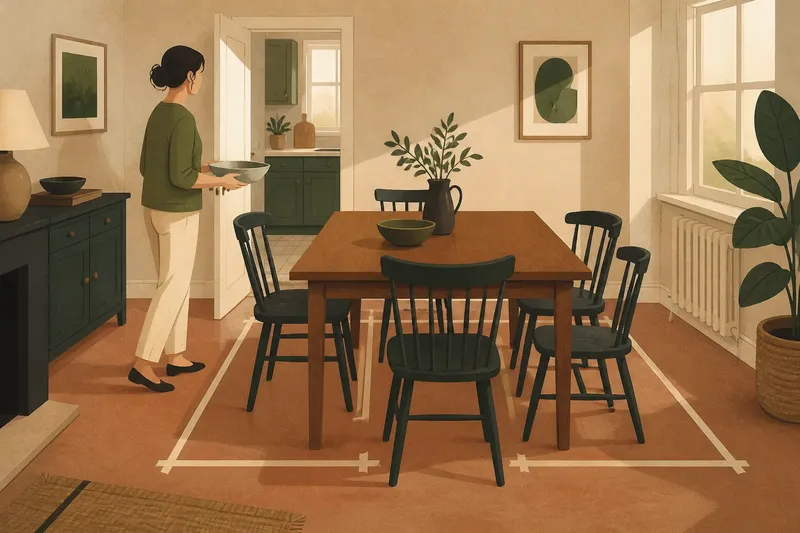
At a narrow dining room’s far end, a rectangular table can leave a clear route past the chairs; in a square breakfast room, the same footprint may feel like a barrier. Choosing a table for the gathering starts with that ordinary walk through the room, then turns to how people will sit, speak and share the meal.
What does the room allow?
Look at the room when it is set for a meal, not when it is empty. Pull out the chairs you already own, open the door into the room, and notice where someone carrying a bowl would naturally pass. A table that fits on paper may still interrupt the route between the kitchen and the seats.
Mark the proposed tabletop on the floor with low-tack masking tape. Set chairs around the outline and sit down; this reveals whether the corners feel close to a doorway, hearth or sideboard. Keep the marking in place through an ordinary household routine if you can, so the shape is judged in use rather than admired from the doorway.
Room proportions offer a useful first clue. A long, slim room often accepts a rectangular table aligned with its length, while a squarer room may make a round or square top feel more settled. These are starting points, not rules: windows, radiators, built-in cupboards and the direction of natural light can change the best arrangement.
How does each shape change conversation?
A round table brings everyone towards a shared centre. There is no head seat defined by a short end, and guests can generally see one another without speaking across a long expanse. It suits meals where conversation is meant to move freely, though a large round top can leave people at opposite sides feeling far apart.
A rectangular table gives the gathering a clear orientation. Its long sides can seat a larger group in a narrow room, and platters can run down the middle; the trade-off is that people at opposite ends may become separate conversational pockets. A centre seat can also feel prominent, which may be welcome for a hosted meal but less relaxed for a casual supper.
An extendable table changes its footprint for the occasion. With leaves stored away, it can serve a smaller daily meal; opened up, it offers additional places without requiring a permanently large top. The extension may alter how guests face one another, and the table’s ends can become less comfortable if chairs are squeezed into a tight room.
Which table suits a changing guest list?
Count the people who regularly eat together, then consider the gatherings that happen often enough to shape the purchase. A table chosen only for an occasional large celebration may occupy valuable floor space every day. Conversely, a compact top that is always crowded can make routine meals feel like a compromise.
Imagine a household with four regular diners and occasional Sunday lunches for relatives. If the room has a clear length but little width, an extendable rectangular table could stay compact for everyday use and open for the larger meal; the observable aim is extra seating without blocking the route to the kitchen. If the room is nearly square and guests usually arrive in similar numbers, a round table may make better use of the available arrangement.
Before choosing an extension, check where the leaves will live and how they are handled. A self-storing leaf avoids a separate cupboard, while a removable one needs a dry, accessible place to lie flat. Ask whether the table opens from one end or separates at the centre, and whether that movement suits the room and the person who will prepare it.
What should you check before deciding?
- Walking routes: Pull out the chairs and trace the path from the doorway to the kitchen. If someone must turn sideways to pass, reconsider the footprint or orientation; if the route stays clear, keep that arrangement on the shortlist.
- Chair shape: Measure the chairs’ actual width, including arms. If they overlap at the table’s corners, choose a different size or seating arrangement; if they fit without touching, retain the candidate for further checks.
- Conversation: Imagine the people who usually gather and how they prefer to talk. If everyone should join one conversation, favour a shape that keeps faces within easy view; if guests prefer smaller conversations, consider whether a longer layout better suits them.
- Daily use: Consider what else happens in the room, such as homework or serving tea. If the table would obstruct those routines, prioritise a smaller everyday footprint; if those tasks still have room, keep the size under consideration.
- Extension storage: Identify a safe, convenient place for any separate leaves. If there is none, look for a design with integrated storage or choose a fixed table; if storage is available, check that the leaves can be reached and handled comfortably.
- Surface care: Consider whether the finish suits hot dishes, spills and frequent wiping. If its care instructions do not suit your routine, compare another finish; if they do, follow the maker’s guidance when using the table.
When the dimensions depend on a product’s construction or the care of a particular finish, check the maker’s instructions before buying; local access requirements may also affect how much clearance a room needs.
How do you compare tables in the showroom?
Do not judge only by the tabletop. Sit in the chairs, check whether knees meet an apron beneath the edge, and notice if the table legs interfere with where people would naturally sit. A pedestal base can free up positions around a round top; with any base design, assess the actual model for steadiness and check how its supports affect chair placement.
Inspect an extendable model both closed and open. Look at the join between the leaves, the position of the supports, and whether the surface remains convenient for serving. If the opened table would press against a wall or leave no room behind a chair, the extra capacity may exist only in theory.
Which questions help settle the choice?
Is a round table better for conversation?
It often makes faces easier to see and avoids a formal head position, so it can encourage a shared conversation. Its success still depends on the room’s proportions and the distance between seats.
Does a rectangular table always seat more people?
Its long sides can use a narrow room efficiently, but the legs, chair widths and available clearance determine how many seats are comfortable. Check the actual arrangement rather than relying on the outline of the top.
Is an extendable table suitable for everyday meals?
It can be, especially when it has a useful compact setting and the leaves are easy to store or keep within the table. Consider how often it will be extended and whether its closed form works for ordinary routines.
Should the table match the room’s shape?
A similar shape can make a room feel orderly, but circulation matters more than a strict match. A round top may soften a boxy room, while a rectangular one can make better use of a narrow space.
For choosing a table for the gathering, the most telling question is not how many seats the catalogue promises, but whether the room can hold the table in its most-used form without making guests navigate around it. Choose the shape that lets people arrive, sit and pass a shared dish naturally; the occasional larger gathering can then be handled by an extension, an extra chair or a different serving arrangement, according to the space you have.